
+86 18840677446
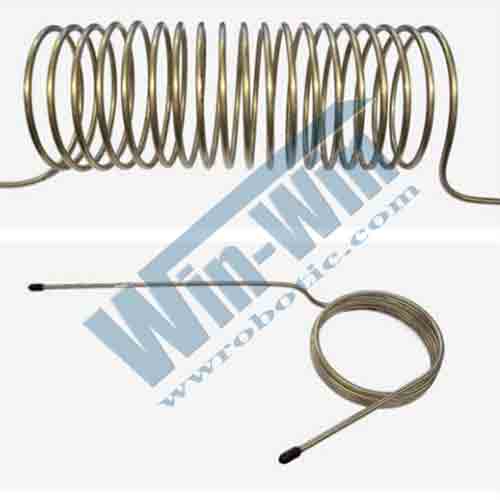
In the structure of robotic water cutting equipment, high-pressure coil tubes are the most important water jet transmission medium. The UHP water flow provided by the intensifier pump is infused into the cutter head through the high-pressure coil and sprayed out through the cutter head nozzle to form enough water pressure to cut the workpiece. It means that the high-pressure coil tubing must withstand sufficient water flow pressure, generally around 60,000 PSI, equal to 420MPA.
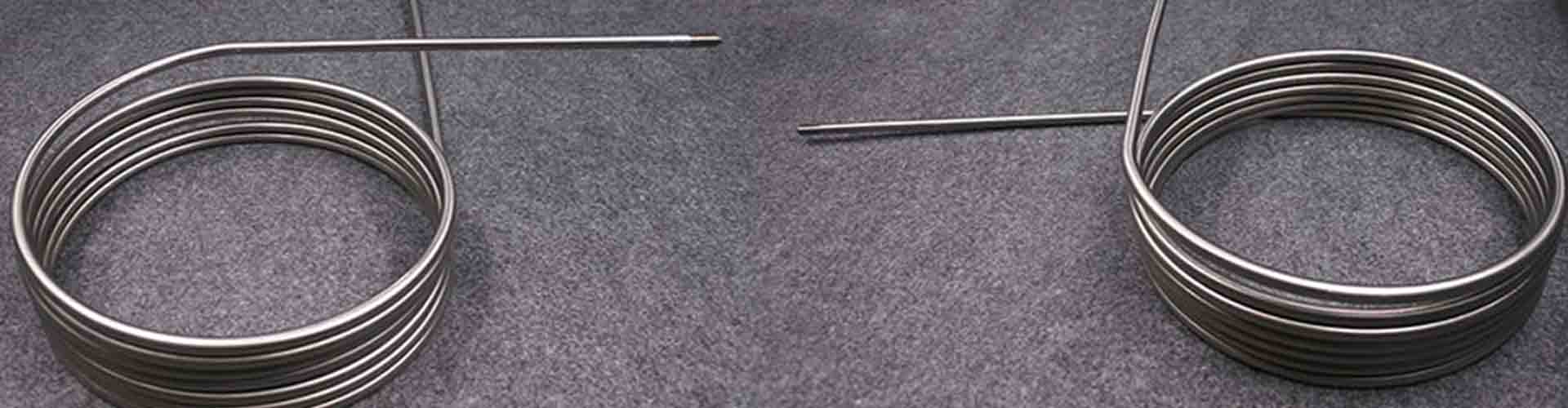
The high-pressure pipe must not only ensure that the material is tough enough to maintain the water pressure, but also be able to bend or hover to meet the "long distance and high flexibility" work requirements of the waterjet cutting robot workstation.
In this way, generally speaking, we can have 2 schemes to achieve this design concept. The first is the more traditional "full circle" design. The long enough 1/4 inch high-pressure tube is coiled into a long spiral body, and then it is surrounded by an independent bracket on the robot arm to form a complete robot water jet transmission system.
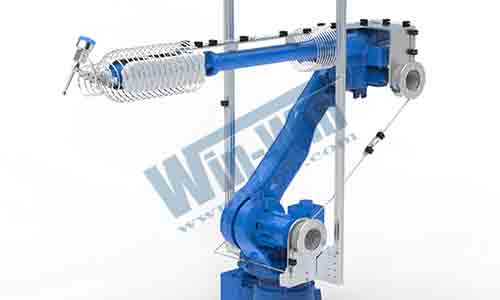 In this scheme, first connect the output connector of the booster pump to the robot workstation with a high-pressure straight pipe and an elbow, and then deliver high-pressure water to the top of the workstation, and then connect it with a spiral coil to introduce high-pressure water into the cutter head.
Generally speaking, on an ABB4600 model robot, a high-pressure coil of about 12 meters is wound around the arm span. This solution wraps all the coils around the periphery of the robot arm, which greatly expands the volume of the entire robot. In the normal operation of the robot, the excessive volume will cause the robot to have a chance to cause unnecessary collisions during the swing motion. At the same time, during the rapid and large movement, the outer body high-pressure coil will sway due to structural problems, thus quickly shortening during the high-pressure process Service life. A coil with a slightly lower quality will therefore burst. Therefore, this solution needs to pay attention to many details during the installation process, including the control of details such as brackets and fixing bolts.
What WIN-WIN needs to adopt is the second set of solutions. We divided the 12-meter coil into two parts and connected them with a straight-through assembly. Each part of the coil is tightly wound by a fixed bracket to form three sets of spiral bodies, which are closely attached to the robot arm.
This solution pursues a multi-stage high-pressure pipe design, which fixes the whole by disassembly separately, thereby reducing the overall volume of bystanders, and strengthening the coil by the multi-stage fixing bracket to achieve stability and non-swaying even when moving at high speed and large scale.
In addition, a straight-through joint with a filtering function can be added at the joint between the two parts of the coil, which can increase the pressure of the high-pressure water once and effectively extend the service life of the cutting head.
Please fill in your information and we will reply you as soon as possible..